

Our Deputy Editor, Erica O’Hara, headed to Georgia to review Lopota Lake Resort & Spa, swapping the usual European escape for the Caucasus mountains, ancient winemaking and a surprisingly enjoyable thrashing with tree branches…
Until recently, if you’d asked me where Europe’s oldest wine-producing region was, I’d almost certainly have embarrassed myself. France? Italy? Spain, perhaps? Wrong. It’s Georgia. More specifically, Kakheti – a lush, mountainous corner of eastern Georgia where archaeologists have uncovered evidence of winemaking dating back more than 8,000 years. Eight. Thousand. Years. Which means when the French were eventually perfecting Bordeaux, the Georgians had already been making wine for several millennia. And yet, despite its extraordinary history, spectacular scenery and fabulous food, Kakheti remains one of Europe’s most overlooked destinations… That probably won’t last much longer.
Since direct flights from London to Tbilisi resumed last year, Georgia has become much easier to reach (the five-hour flight is much more comfortable than you’d think), and for travellers willing to look beyond the usual European suspects, it offers something that’s becoming increasingly difficult to find: authenticity. Here, family-run wineries outnumber flashy tasting rooms, monks still make wine in monasteries and lunch has a habit of turning into a four-hour affair.
And if you’re wondering where to base yourself while exploring Georgia’s celebrated wine country, the answer is Lopota Lake Resort & Spa. Spread across 60 hectares of lakes, forests and vineyards beneath the Caucasus Mountains, the more I discovered of this family-run resort, the more I fell head over heels in love with it.

So, What’s The Resort Like?
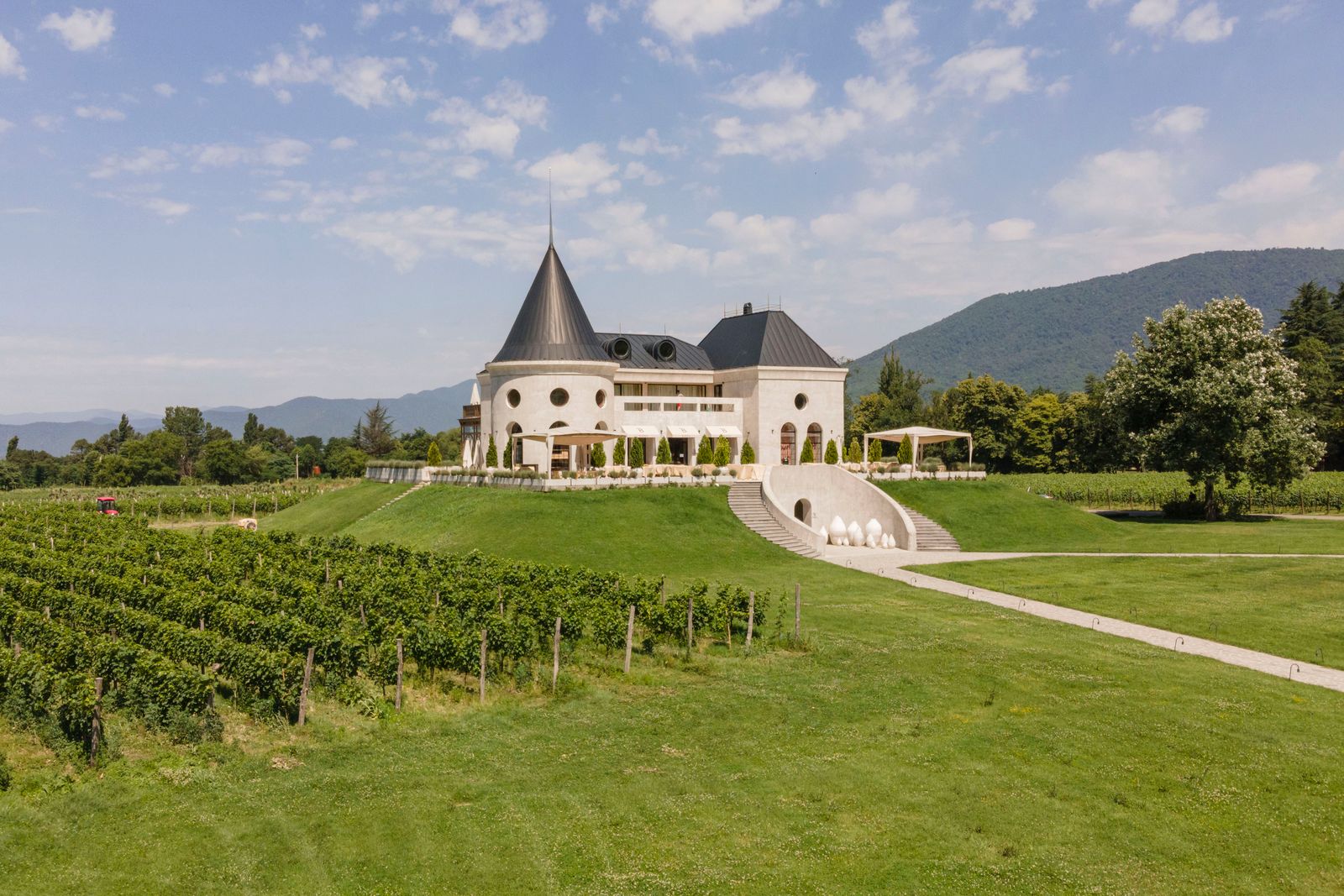
By the time we reached the final winding roads to Lopota Lake Resort & Spa, my ears started to pop from the altitude. It was dark by the time we arrived, so my first introduction to the resort wasn’t the scenery but the soundtrack: an enthusiastic chorus of frogs croaking somewhere by the lake. It wasn’t until I woke up the next morning and made my way to breakfast that Lopota fully revealed itself. The Caucasus Mountains towered over the lake, the fairytale turrets of the on-site winery pierced the sky, horses grazed in the distance, and a gaggle of geese casually wandered past me as if they, too, had booked a lake view room. I had to stop for a moment to take it all in because it was quite literally breathtaking – a heavenly contrast to the South London flat I had left just 24 hours before.
Nature isn’t something that’s been carefully landscaped around the resort – it is the resort. Even after several days, I found myself stopping every few minutes to admire the view, because there’s one in every direction. It’s difficult to believe this sprawling estate began life with just seven guest rooms.

What’s The Story Behind It?
Back in 2008, founder Goga Maisuradze imagined something few others could: a world-class destination in a corner of Georgia that, at the time, barely registered on international tourism maps. Over the years, his vision steadily and organically grew into today’s resort, which now encompasses 311 rooms across 16 buildings, multiple restaurants, an award-winning winery, six pools, horse stables, a spa, and a seemingly endless list of activities. Normally, resorts with this many facilities end up sacrificing soul for scale. But Lopota has both.
It’s more village than resort – a very nice village, that is – and much of that comes down to the family who still run it. Following Goga’s passing, the resort was taken on by his daughters, Ana and Elene, alongside the wider family, all of whom remain involved in day-to-day life here. Ana and her family even live on the estate, and near the entrance stands a statue of the family’s much-loved late dog – a small detail perhaps, but one that tells you rather a lot about the family values at the heart of Lopota.
During my stay, Ana told me she’d been coming to the lake with her father since she was a girl, and spoke passionately not just about the future of the resort but about preserving the nature surrounding it and supporting the local community. At one point she mentioned that guests regularly ask whether they can buy homes on the estate. I completely understood the temptation…
Are The Rooms Nice?
They are. Today’s Lopota looks surprisingly cohesive considering it evolved over almost two decades. Traditional chalet-style buildings sit beside sleek contemporary architecture spread out across the estate and softened by timber, stone and greenery that almost camouflage them against the surrounding landscape. My room in building 15 overlooked the lake, with its own terrace for morning coffee and convenient proximity to the breakfast buffet. Inside, natural wood, soft green tones and subtle botanical touches reflect the scenery outside.
The cleverest thing about this multi-building setup is how spacious it makes everything feel despite the resort’s 311 rooms. One morning, I decided to walk the perimeter of the entire estate and passed only a handful of other guests, despite learning that the resort was at full capacity.
That sense of space means Lopota can be several things at once. There’s plenty here for families, couples and solo travellers, but you never feel as though you’re on top of one another. Families can make the most of the water park and activities while someone else disappears to the spa or finds a quiet corner by the lake, and neither experience intrudes on the other. And that’s perhaps one of Lopota’s greatest luxuries.

Now, About That Wine…
You can’t really visit Kakheti without leaning wholeheartedly into its wine culture. And Lopota makes that exceptionally easy. The resort’s own Château Buera sits proudly among rows of vines overlooking the estate, looking every bit the fairytale château as the sun sets. But it’s not just there to produce a pretty photograph (though it does this very well, too). A tour through the winery introduces guests to Georgia’s extraordinary 8,000-year-old winemaking tradition, centred around the ancient qvevri method, where huge clay vessels are buried underground and grapes ferment slowly with their skins, stalks and seeds – a process that’s remained largely unchanged for thousands of years. Which means Georgia was making amber wine (or orange wine, as you might know it) thousands of years before East London decided to call it trendy.
The resort also makes a brilliant base for exploring the wider Kakheti region. We visited family-run wineries, met fourth-generation craftsmen who hand-build enormous qvevri clay pots, and sampled wines made by monks inside the UNESCO-recognised Alaverdi Monastery. Even if your wine knowledge begins and ends with “red, white or rosé”, it’s impossible not to be fascinated by a culture that has been making the stuff for longer than most of us can comprehend.
Talk To Me About The Food…
If there’s one thing Georgians take as seriously as wine, it’s feeding people. I’d heard about Georgian hospitality before arriving, and like most travel clichés, I assumed it had probably been exaggerated. It had not. Hospitality here isn’t a concept; it’s a culture, and it’s woven into almost every experience.
Our introduction came during a Georgian cooking masterclass, where we learned to make traditional khinkali dumplings (with varying results) alongside shoti bread baked in a clay oven and churchkhela, the country’s famous walnut-and-grape confection that looks a bit like a wonky candle. Lunch followed in Kakhetian Corner, the resort’s Georgian restaurant with a treehouse overlooking the lake, where baskets of bread appeared alongside local cheeses, and countless bowls of walnut-based sauces. Walnuts are everywhere in Georgian cooking, and after tasting them this fresh, you’ll wonder what on earth we’ve been eating in Britain.

And the food kept coming. Communal tables groaned beneath platters of smoky charcoal-grilled meats, bubbling khachapuri, fresh herbs, pickles and colourful vegetables – unpretentious food that relies entirely on the quality of its ingredients. As we ate, a group of local singers performed traditional Georgian polyphonic songs, their spine-tingling harmonies drifting across the water while we tore bread, passed plates and drank amber wine overlooking the mountains. This was one of those travel experiences you cannot manufacture, and one I’ll never forget.
Elsewhere, Lopota offers sophisticated Asian fusion at IKE, Italian comfort food at Oval and Georgian-fusion dining at Château Buera, where dinner comes with sweeping vineyard views and a front-row seat to Kakheti’s spectacular sunsets.

You Mentioned A Spa?
After several days indulging in Georgia’s food and wine, I made my way to the Forest Spa for even more relaxation. Cocooned by trees and overlooking the lake, the spa’s signature wine bath – or vinotherapy experience if we’re being technical – is one of the main draws. Whether it genuinely boosts circulation and rejuvenates skin as promised, I’ll leave to the experts. What I can confirm is that soaking in warm, wine-infused water while gazing across the lake with a glass of wine in hand is an excellent way to spend an afternoon. A full-body massage afterwards left me feeling lighter than air.
If you want something more invigorating, however, you’ll find it on the opposite side of the lake.

How Invigorating Are We Talking?
The Slavic Bath experience sounds, on paper, alarming. The ritual involves sitting in an intensely hot wooden sauna before being repeatedly slapped with bundles of fragrant leafy linden branches, followed by either an icy plunge pool or, in my case, allowing a Belarusian man named Aleksei to gleefully release a barrel of cold water directly over my head. The intense heat, vigorous sweeping and tapping of the leaves and sudden cold are designed to improve skin health, stimulate circulation, relax the muscles, and leave you feeling thoroughly invigorated. Written down it sounds absolutely dreadful – I’d be lying if I said I wasn’t apprehensive going into it – but I’d also be lying if I said it wasn’t one of the highlights of the trip.
The team delivers the experience with equal measures of expertise and humour (which helps enormously when somebody is encouraging you into a sauna to be whipped with vegetation), serving restorative herbal tea, local honey and homemade biscuits between each round.
What Else Is There To Do?
The question is rather, what isn’t there to do? There are horse rides through the surrounding countryside, quad biking beneath the Caucasus Mountains, cycling trails, paddle boats, tennis courts and pools, an indoor wellness complex and an aqua park and ice rink for families. I went quad biking and, despite being terrified beforehand, absolutely loved it. Between this and voluntarily allowing myself to be whipped with tree branches, Lopota seemed to bring out an adventurous side of me I didn’t know was there.
The jazz club is well worth a visit too. Built as one of founder Goga Maisuradze’s long-held ambitions, the huge curved structure of concrete, stone and locally sourced timber should look completely incongruous among all this greenery. But it works. Inside, it’s dark and atmospheric, with Georgian musicians taking to the stage on weekends.

So, What’s The Verdict?
Lopota is, above all else, a celebration of life’s simple pleasures – and one of the most special places I’ve ever stayed. For all there is to do here, what stayed with me most was the beauty of the lake and the mountains, the extraordinary sense of space, the ancient winemaking traditions, and the warmth and generosity of the people who make this pocket of Georgia what it is.
As a country girl who happens to live in one of the busiest cities in the world, I’d forgotten just how restorative those simple pleasures can be, and it broke my heart a bit to leave. Although, having discovered that Lopota hosts its own Rtveli celebration at Château Buera in late September (an annual havest festival with grape picking and pressing, wine tastings, a Georgian supra and live music), I think I’ve already found a very good excuse to go back.
Georgia may still fly under the radar for many travellers, but if Lopota is anything to go by, the secret won’t stay secret for much longer. My only advice? Go sooner rather than later.
Rooms at Lopota Lake Resort & Spa start from €160 per night. For more information or to book your stay, visit lopotaresort.com.
Loved reading Erica’s review of Lopota Lake Resort & Spa? Discover more of our latest travel features and hotel reviews.


