
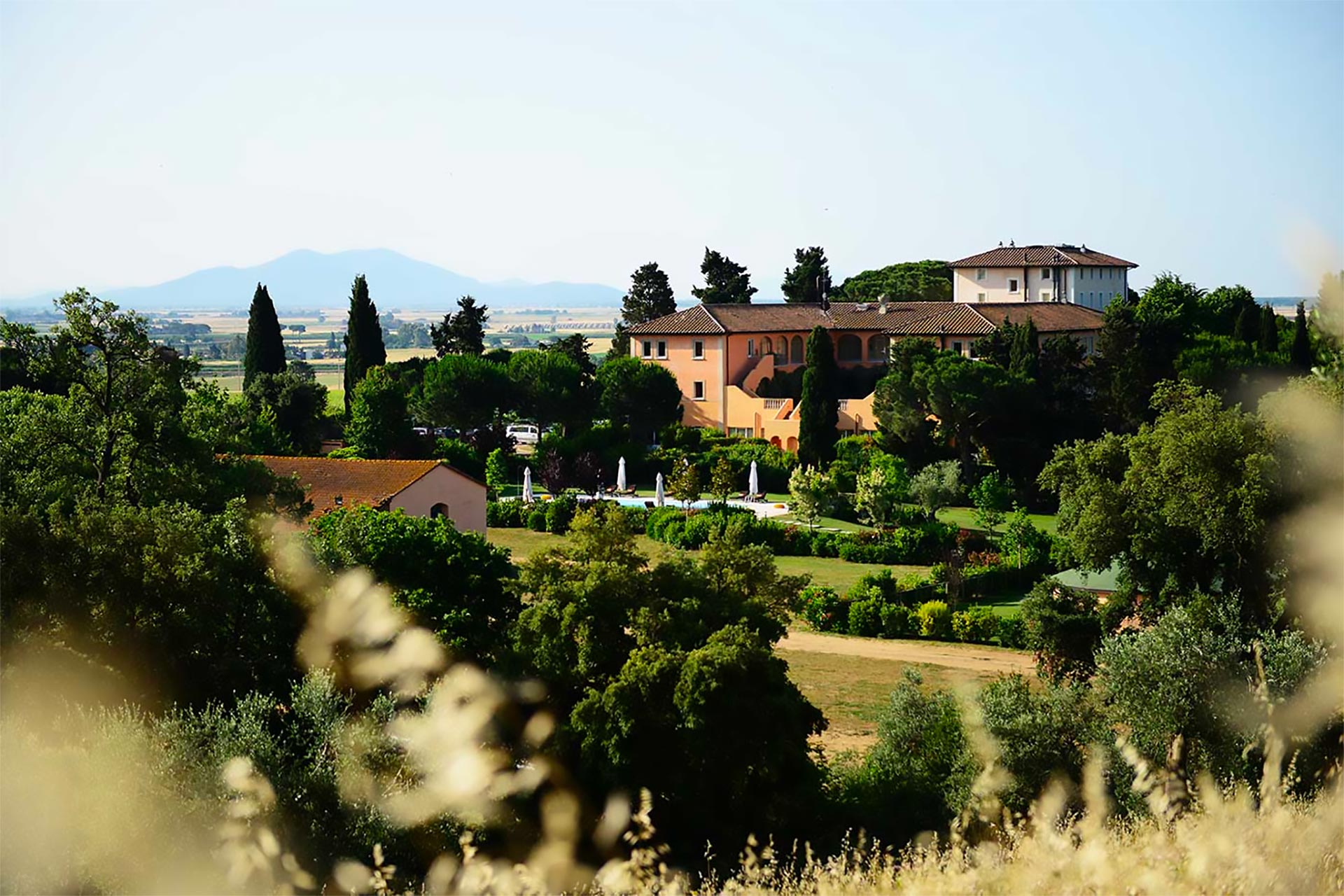

We sent Ari to review L’Albereta in Northern Italy. Where he nailed the brief: eat. A lot…
My current bedtime book isn’t a novel, or, unlike most men my age, a heavyweight historical tome about Churchill. It’s a cookery book. ‘Italian Food’ by Elizabeth David was originally published over 70 years ago, in the mid fifties. This was the era of Brown Windsor soup. It was the period Fanny Craddock introduced Brits to the exotic concept of the prawn cocktail. Rationing was still a thing. In fact, ‘Italian Food’ was first published in 1954, the year rationing finally ended. A time when people here were slowly chewing their way out of years of hard tack and abstinence. So, perhaps not the most fertile ground on which to sow the seeds of Italian cuisine.
Yet, this became one of the most popular cookery books ever written. It’s constantly cited by famous chefs as having provided their initial inspiration to get behind the stove. In amongst the practical 1950s advice (source olive oil from your chemist; you sure as hell wouldn’t find it in a grocery store in those days), David sets out the basic philosophy of Italian cuisine. Fierce regionality, combined with a willingness to spend all day preparing a meal, but very little time actually cooking it, pretty much sums it up. And if you think about the hours it takes to make tortellini from scratch vs how long it takes to boil up the little buggers, you can see her point.

Another key element of Italian cuisine is to obtain the freshest of ingredients. Another reason Italians don’t generally like to cook food for ages, she explains, is they respect retaining this freshness in the finished dish. And they also stick to the mantra only to use ingredients that are in season. This all leads to meals far removed from the fancy-pants, long-simmered sauces, richness and general fuss of French cuisine. Which, until Elizabeth David came along, was considered the sine qua non of sophisticated continental cuisine.
David sets out the basic philosophy of Italian cuisine…
What people liked about this book then, and still do now (it remains in publication and popular as ever), is that David reflected this philosophy of simplicity, letting the ingredients shine, in her simple, sparse prose. It’s a wonderful book and was the perfect warm up for my trip to review L’Albereta, a five star hotel hidden away in the lake filled Franciacorta region of Italy, with a long and illustrious culinary history all of its own.
Before I tell you about L’Albereta, I’ve got a little back story. A few weeks’ ago, I ended up sat next to an Italian guy from Alba (infamous for its white truffles) on the return leg of a press trip. I happened to mention that I was heading to L’Albereta in a few weeks’ time. Before I said this , my fellow traveller had been on the taciturn side of conviviality. But at the mention of this restaurant, his face lit up. He started gesticulating like, well, like an Italian.
At the mention of this restaurant, his face lit up….
‘This was the birthplace of modern Italian food’ he declared, eyes shining with zeal. And then, in the way a Catholic might say a catechism (sorry if this line makes little sense, I’m a committed atheist and ignorant about the finer details of popery, but always happy to pray at the altar of alliteration), he whispered reverently, ‘But of course you must know of Gualtiero Marchesi? I hadn’t a clue who this was, but he didn’t seem to notice my slightly shameful shake of the head, so in thrall was he to the memory of this chef.
Having done a little homework since, I’ve discovered Marchesi, who died, aged a ripe old 87, a decade ago, was basically the godfather of Italian nouvelle cuisine, just as Alba-man claimed. And it was Marchesi who set up the restaurant at L’Albereta. This legend’s memory clearly lingers. The ethos at the hotel’s four restaurants is still very much reflective of the OG(ualtieri)’s focuses. These are seasonality and the freshness and quality of the base ingredients. They build every dish on these.

Day 1
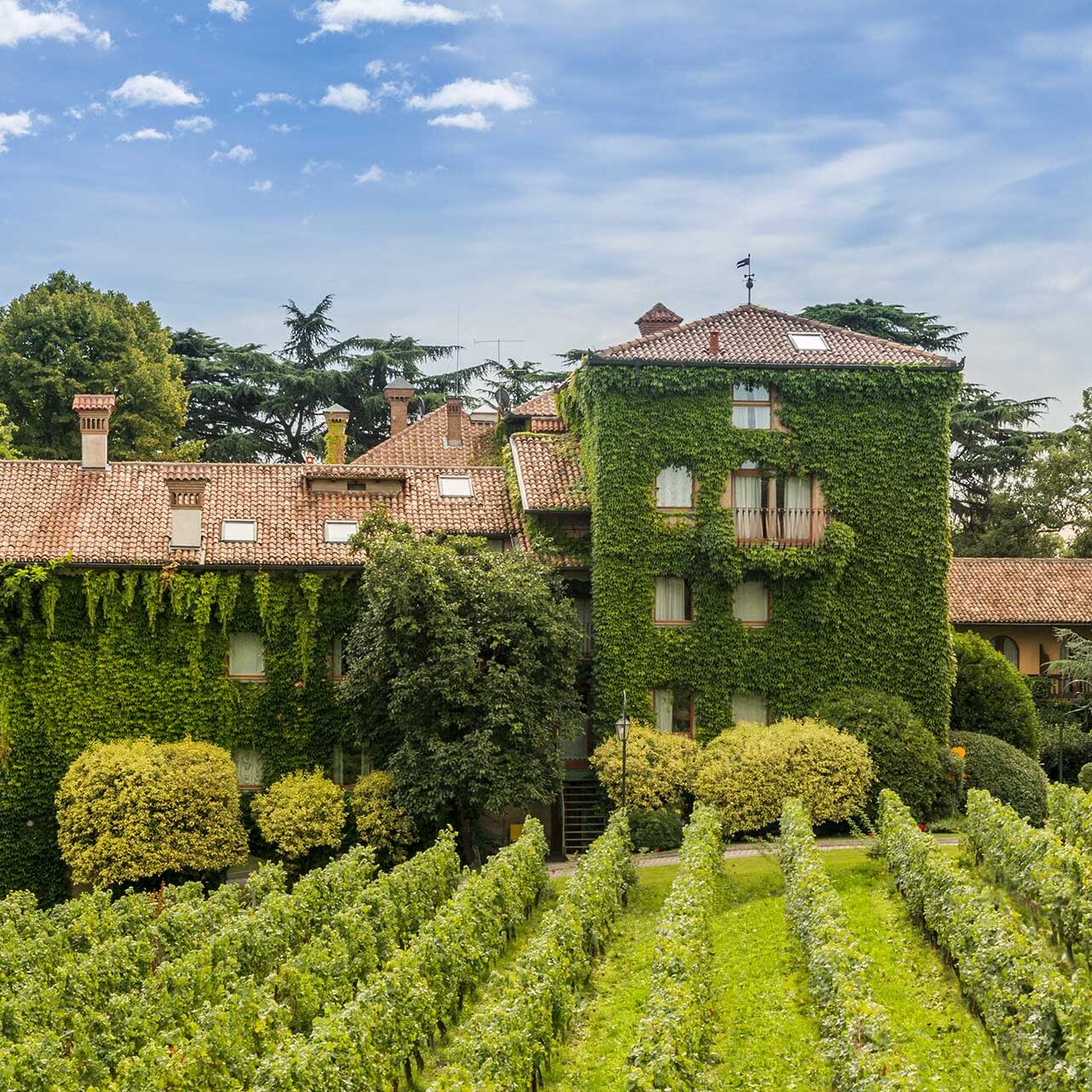
I arrived on a Friday afternoon, the hotel a rapid half hour transfer from Milan Bergamo airport, to find L’Albereta looking pretty as a picture, tucked into verdant, hilly wine country, overlooking Lake Iseo. Iseo is relatively unknown by comparison to its infamous neighbours, Garda and Como. As a result, it’s far more peaceful and less tourist thronged than gorgeous George’s pond.
Tucked into verdant, hilly wine country, overlooking Lake Iseo…
The hotel is part of the ever dependable and seriously high-end Relais and Chateau group. I was, nevertheless, taken aback by the warm welcome and effortless elegance of the staff. Posh hotels aren’t always friendly, but here you get to mix luxe with the feeling you can treat this as a home from home, rather than be bound by formal rules and stiff service. We were given a quick tour on arrival, with a promise of a proper walk around the grounds with one of the senior team when we’d settled in. That’s the perfect way to welcome somone. The bare necessities of what you need to know up front, with more information available on tap once you’ve relaxed and unpacked. Bravo.
Our room, a twin overlooking the gardens on the second floor, was decked out in pale wood, marble and muted gold. The lingua Franca of discrete wealth. It had a cute little sitting room, a bathroom the size of a standard London flat and the right mix of old world elegance with modern touches such as USB chargers by the bed. It was a deluxe, so one up from the entry level superior rooms. And rates start from 550 euros a night. If you fancied a splurge, there are junior and principal suites available with all the bells and whistles. And for which you’re looking at four figures per night.
Pale wood, marble and muted gold. The lingua Franca of discrete wealth….
For our first dinner, we headed down to what the hotel describe as their casual dining restaurant, Leone Felice. Do not for a minute think this means guests will be slouching around in onesies. This is Lombardy, not Florida, and my fellow diners were suitably chic in business class layers of cashmere and suede. An entire wall of the restaurant is given over to glass. This proves almost every guest with a lake view, bringing the verdant gardens into the space.
The menu was divvied into ‘vegetables’ ‘pasta’ ‘fish’ and ‘meat’. And the utterly fabulous front of house team encouraged us to pick one from each. The dishes range in price from 20 to 50 euros with the average being around the 30 mark.


I started with crispy courgette flowers stuffed with a lemon infused ricotta. With this we had a first taste of the region’s famous sparkling wine, Franciacorta. Bellavista vineyards Alma l’Assemblage no 1′, was where we began. It was a lemony, gingerbread fizz with a hint of baked apples. A great match for the richness of the ricotta.
Do not for a minute think this means guests will be slouching around in onesies…
Sparkling wines from Franciacorta are, in the main, delicate, light and floral, made using the same fermentation process as Champagne. You get the same fine mousse (what they call lots of little bubbles in the wine trade) good Champagne has. Along with a similar dry, subtle finish. Which means it tasted nothing like far sweeter and less structured Prosecco which has, unfortunately, become Italy’s ubiquitous bubbly but for me is always too flabby and sugary to enjoy more than half a sip of. Alma’s a cuvée from one of the region’s great producers. So expect to pay upwards of £40 a bottle for this (retail). I’d therefore guess you’d be paying near £100 in a restaurant (our drinks were on the house so I don’t know what they cost; yes, I know, I’ve got my hand on my tiny violin as we speak).
From the pasta section we deliberately chose something that sounded incomprehensible and outlandish. Tagliatelle stuffed with beef. Now to anyone with even a passing understanding of physics, stuffing a flat, noodle shaped ribbon of pasta is clearly impossible. What arrived though, was a single giant rolled ribbon of pasta shaped into a coil, into which ground veal, rocket and strachitunt (like a mild Gorgonzola, made in nearby Bergamo) cheese had been stuffed. To make things even more surreal, the pasta had been died purple with beetroot juice. This makes the whole thing look like a curled up octopus.
It’s pretty hard these days to conceive a dish that’s novel in every sense but they absolutely managed it…
Convinced by our waiter when we ordered that we would manage the full four courses (‘the night is young and we have much wine for you to try’) was his very effective sales pitch), I then had liquorice infused duck breast with roasted plums. The meat was perfectly pink, well rested, all the fat under the crisped skin rendered out. It’s hard to overestimate how difficult that triumvirate is to achieve with duck. Just think about how each of those elements work against each other. The longer you cook the duck the crispier the skin but the more overcooked the flesh will be. Resting is required to ensure the meat is tender and doesn’t bleed onto the plate. But for every minute the bird sits on the board the skin gets more flaccid. Not here. It was all miraculously on point.
My only quibble was the plum hadn’t been roasted enough to release its juices. But this plate was otherwise a total triumph. We drank a superlative strawberry scented Bourgogne rouge from Olivier Leflaive with the mains and counted our blessings to have won at the game of dinner.


Day 2
Slightly groggy from the wine the night before, we started the day with a continental breakfast back in Leone Felice. I only found out as I was leaving this isn’t the name of the founder, but instead means ‘lucky lion’. Over truly excellent coffee we built ourselves an eclectic breakfast of artichoke hearts, bresaola, olive bread and home churned butter. With some fresh berries to finish it off.
We started the day with a continental breakfast back in Leone Felice…
Already feeling only half as rough as when I woke up, I got my body back into tip top form with an hour long detoxification massage at the hotel’s Chenot spa. Paula, my experienced and worldly-wise therapist, delighted in informing me that my body, whilst fairly relaxed and at peace, was definitely in need of some detox. Especially, she emphasised, my kidneys.
What followed was a combination of full-body massage with cupping (to draw out the bad stuff from my lymph nodes. Of course…). You can spend six days at Chenot giving your body the full monty for around 5,000 euros (room not included). But I had neither the cash nor inclination for this kind of commitment. So instead I made do with a single treatment, fixing me up sufficiently to have me reaching for a fresh bottle of fizz. This detox would set you back a far less terrifying 185 euros. A bargain if it gets you back onto the bottle after a heavy night.
No sooner had I repaired myself than we jumped into one of the hotel’s golf buggies and headed to Bellavista vineyard for a wine tasting/retox. Both Bellavista and L’Albereta are owned by the Moretti family. They very much remain hands-on at both hotel and winery. There’s something particularly magical about family-owned properties. They have a heart and character. They’re unique, built on their history and blood-ties and a continuity of approach handed down through the generations.
There’s something particularly magical about family-owned properties…
Here the family’s involvement at Bellavista was apparent. Both through the name of their top cuvée (named after patriarch Vittorio Moretti) and the large plaques on the wall of the vast cellars, for each of the principal family members. I’ve been to a fair few wine tastings, many of which are an unfortunate blend of formal and uninformative. This was the opposite.
We were led on a tour of the truly impressive caves by a young Italian student (taking a degree in International Relations) who moonlights as a guide at the weekends. After an hour or so checking out the barrels and bottles and learning about the way they make and age Franciacorta (up to a whopping 70 months for the top Bellavista wines), we settled into the tasting room. Our 65 euro tour included three glasses of fizz, from the entry-ish level Alma assemblage 2, up to the 70-month-aged Vittorio Moretti which retails at 110 euros a bottle and they only make it in years when conditions are perfect, just like top notch vintage Champagne. We lingered for another hour, sat at huge round tables overlooking the beautiful swing and fountain that sit outside the vineyard’s entrance.


Bellavista is undoubtedly impressive, the triple height monogrammed double doors into the cellars looking like something out of Willie Wonka. But that doesn’t mean anything if the wines don’t live up to it. Luckily for us these sparklers were genuinely high quality and a real match-up against their equivalent price points in Champagne. The cuvee Moretti tasted a little like young Dom Perignon, yeasty, creamy and subtle. And you can’t get much better than Dom P in Champagne. Adding to the glamour of this place we discovered previous guests included Sophia Loren and Pavarotti. And now, me.
these sparklers were genuinely high quality and a real match-up against their equivalent price points in Champagne…
Our final dinner was at L’Albereta’s Michelin star restaurant L’Aurum. White curved dining room. Huge tables spaced miles apart. A full phalanx of staff. Very expensive flower arrangements. So all the usual boxes ticked for the star brigade. And look, I’m not complaining too much about what was an interesting and inventive meal. But it’s fair to say this was a hit and miss experience.
The amuses were outstandingly impressive from a technical perspective. Hours and hours of work and undoubted skill had gone into little bites including a multicoloured sphere that when bitten, exploded with each flavour of a caponata and a salted sorrel leaf that tasted incredible for the nanosecond it took to eat.
But there were also a fair few dishes marred by a jarring sweetness. The tomato sauce they drizzled around the risotto was as sugary as chip shop ketchup. And the camomile consommé, poured over an otherwise delicious dish of raw beef and micro vegetables, tasted like it should have been served with the puddings.
The amuses were outstandingly impressive from a technical perspective…
There was however one standout dish that made me forgive and forget these faults. A plate of at least 20 seeds and vegetables, each given a different treatment; compressed, reduced, rendered into little blobs, grilled, toasted, pickled, jellied and raw. It was an extraordinary homage to the garden, looked like a work of art and, most importantly, ate beautifully. This was the dish that most evoked the spirit of Marchesi. It was a hymn to fresh produce and vitality, although the clear tomato water jelly owed a fair bit to Alain Ducasse, with whom current head chef at L’Aurum, Alberto Quadrio, used to work.
On my last morning, the sun came out and I spent a couple hours in the hotel’s lush gardens, reading, gently tanning and pinching myself for scoring the best gig in the world.
I left L’Albereta as a procession of some of the world’s rarest vintage cars, including a 1960s Ferrari of quite epic beauty, arrived, for an event allied with the famous Mille Miglia classic rally. Old school, understated luxury. Just like L’Albereta itself.
Find it: Via Vittorio Emanuele, 23, 25030 Erbusco BS, Italy
Click it: www.albereta.it
‘Gram it: @albereta

Thank you Ari for taking the gastronomic hit on behalf of all of us in this review of L’Albereta. Before you pack your bags for Northern Italy, dear reader, check out more of our travel. There’s plenty to choose from…


