
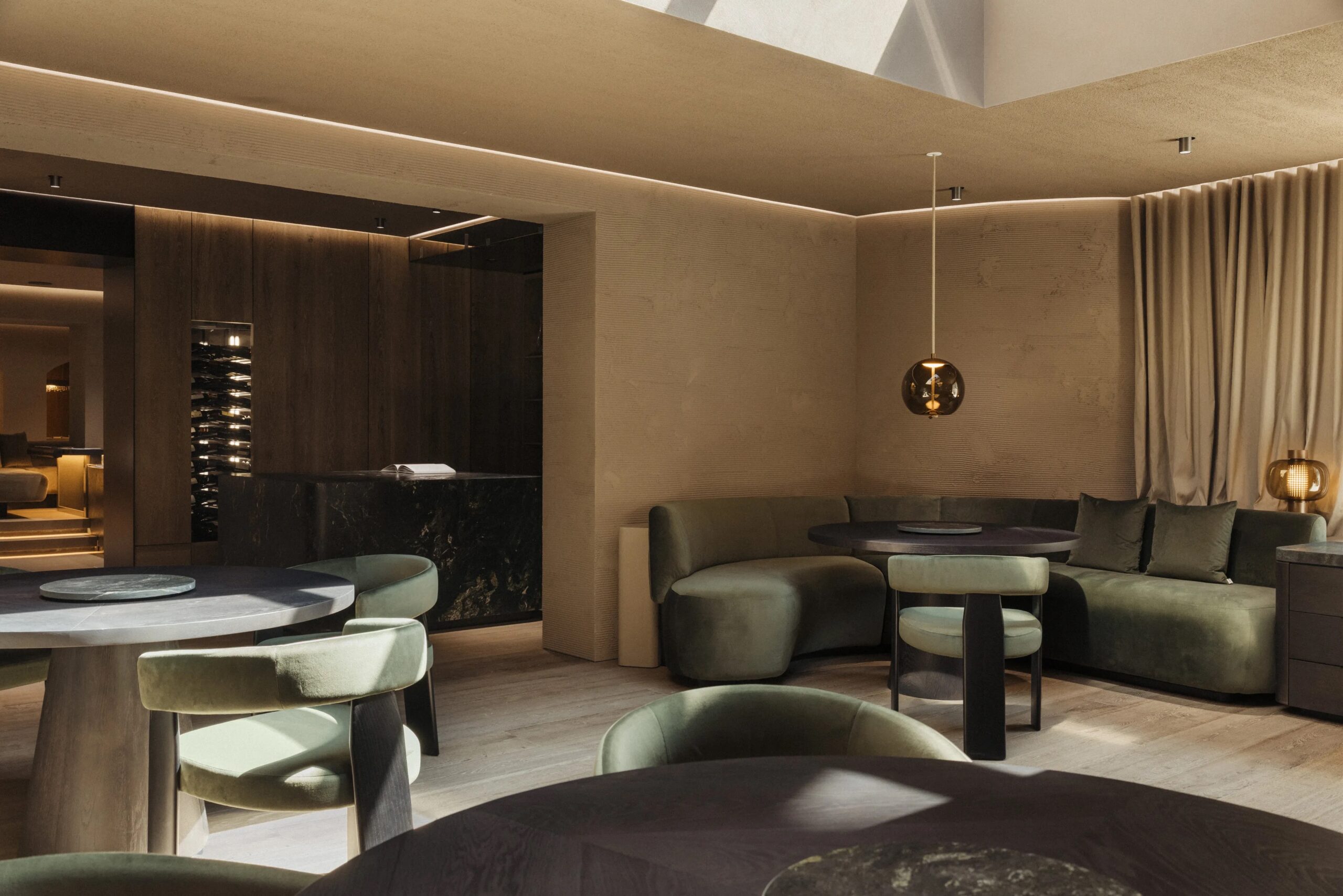

Up at four in the morning. Cab down to Gatwick. Two-hour flight to Innsbruck, Austria. Another cab to take me ninety minutes up winding mountain roads, to the ski town of Obergurgl. Total journey time, seven hours, each way. And all this was for a dinner. Not just any dinner, mind. The Gourmet and Wine Hotel, Austria (known simply as The Austria, to locals and regulars) was hosting a wine dinner, the brainchild of its owner and head sommelier, Maximilian Steiner. The idea was to showcase (and review) the hotel’s 16-seat restaurant, Austria Stüben, whose chef, Verena Stattman, has held a Michelin star since 2025. Maximilian, with his sister Anna is the third generation of the Steiner family to run the place, and it’s very much a family affair, with other Steiners also involved, including at their sister hotel next door, The Bellevue.
As well as the promise of a ten-course feast prepared by chef Stattman, what made this meal worth the journey were the wines Maximilian had chosen to accompany each course. They were, without a doubt, the greatest vinous lineup I’ve ever seen on a menu. Maximilian won the title of Austria’s best sommelier a couple years’ back. His expertise, together with the astonishing cellar at The Austria, made quite the match.

I cannot possibly describe every one of the ten wines we drank. Similarly, I would exhaust your patience if I tried to run through every food course. So, instead, I’m picking my food and drink standouts from this epic meal.
What made this meal worth the journey were the wines Maximilian had chosen…
After a trio of snacks (mushroom taco, cheese gougère and a prawn spring roll) which were fine, if slightly stodgy and unspectacular, we had our first proper starter. Tyrolean Gröstl. This traditional Alpine hearty (and heavy) dish usually involves roast potatoes, chunks of bacon and a fried egg seasoned with marjoram. It’s the sort of food you want after a day’s skiing. But the kitchen at Austria Stüben had lightened it, giving the Gröstl a modern glow up. Long-cooked, pulled-beef (in place of the pork) sat under an airy cushion of roast potato espuma, bound with a little emulsified egg yolk. Delicate, balanced and handled with a deft touch, it was a dish which gave a nod to the past whilst having both feet firmly in the future.
I suggested to Maximilian that they could evolve a second version of their take on Gröstl, substituting caviar for the beef. I’m hoping to discover whether the potato foam is as perfect a match for caviar as I suspect, when I next return.
The Gröstl came paired with a Bourgogne Aligoté. Now, 99 times out of a hundred, Aligoté is a one note and uninspiring wine. It’s usually so bland that the French use it for Kir. Which means it’s basically the kind of plonk that’s improved by adding grown-up Ribena to it. But, there’s one producer who can work magic with Aligoté.
Jean-Marc Roulot is a Burgundian genius. His Meursaults sell for hundreds a bottle. Roulot changed the game in Meursault, moving away from the heavy oak and thick, buttery finish with which this Burgundy was previously synonymous, to a much more nuanced, lighter style.
Jean-Marc Roulot is a Burgundian genius…
His Aligoté was simply superb. High acidity and a lemony, laser focus cut through the Grostl’s richness, with plenty of grape on the nose to keep things interesting. It was my favourite pairing of the night, although not quite my favourite wine.
That accolade belonged to a 1989 Cos D’Estournel, poured from magnum and which tasted at least ten years’ younger than it was. This is one my favourite clarets in any vintage. And 1989 was a legendary vintage, almost up there with the unsurpassed 1982. It was still fresh, youthful and vibrant, despite being nearly forty years’ old. As it was decanted, it filled the glass with aromas of blackberry, mocha, leather, filling me with joy.
I’ll be honest, I disliked what it was paired with… A slightly vinegary cabbage and parsnip dish that felt a little like the kitchen were trying to be too clever. But I didn’t care. The wine was sublime enough to enjoy on its own. And the cabbage dish was, to be fair, anomalous.


There were plenty of courses I did love. The best of the bunch, for me, was a veal sweetbread in a sweet sour sherry sauce. The veal gland was cooked crunchy on the outside, creamy within and cut through perfectly with the sherry sauce. And it came with an equally outstanding wine. A ten-year-old Puligny Montrachet Premier Cru by Francois Carillon, served in magnum, like the Cos. Rounded, mellow, lightly oaky and voluptuous in the mouth, it mirrored the richness of the sweetbread, rather than fighting it.
The best of the bunch, for me, was a veal sweetbread in a sweet sour sherry sauce…
The reason why magnums of old wine drink better than bottles, is all about physics. Indeed, it’s the only physics I know about. In a magnum, less air comes into contact with the wine, by proportion, than in a bottle. This slows down the ageing process, meaning your magnum will outlive (and outperform) a bottle after a few years in the cellar. It’s one reason why magnums tend to cost a bit more than simply double the price of a bottle of an identical wine. Right, I’ll put the mortar board away and get back to dinner.
There was so much more about this meal that hasn’t made it onto the page. For example, I didn’t tell you all about the salted, dehydrated watermelon with ponzu dressing, served with a semi-dry Junmai Ginjo Lei sake. It was a bold and unusual dish/pairing I would never have expected to have been served in Austria. So it deserves, at least, this brief mention.
But my final few words have to be reserved for an unbelievably rare wine that we drank, paired with a pale slab of Danube salmon, our fifth course of the evening. It was at this stage that Maximilian popped the cork on a magnum of 2015 Salon. This 100% Chardonnay sparkler is, quite simply, the rarest and greatest of all Champagnes. It’s made with grapes from a single Grand Cru village in Champagne and only in years deemed good enough to declare a vintage. It would have cost thousands to drink this in a restaurant in London. It was a total privilege to try, and the first time I’ve ever experienced it.
Quite simply, the rarest and greatest of all Champagnes…
The very first sip was arresting. Tiny bubbles, a clean, saline, chalky, seriously long finish and real tension on the tongue. It’s a wine for geeks, not as rich and blowsy as Krug, instead providing a subtle, delicate and ethereal pleasure. I knew as I drank it these would likely be my first and last sips of Salon. I don’t have pockets deep enough for this stuff and I don’t know any other restaurateur generous enough to lay it on, as Maximilian and his team did.
Hopefully you now understand why I flew across Europe to spend fewer than 48hrs in Gurgl. This was a meal too magnificent to miss. And if Austria Stüben host another one, perhaps in honour of my caviared Grostl, I’ll be the first on the flight.
Find it: Kressbrunnenweg 3 & 4/U3, A-6456 Obergurgl, Tirol, Austria.
Click it: www.austria-bellevue.com
‘Gram it: @austria_gourmetwinehotel

Forget skiing, this will have me rushing to Obergurgl to gurgle down any of these wines. If Ari’s review of Austria Stüben makes you feel the same, read more like it here. And for moire from the brilliant Ari himself, click here…


